Product Description
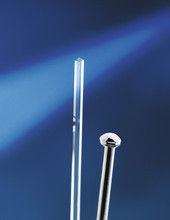
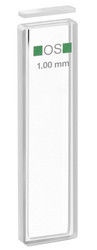
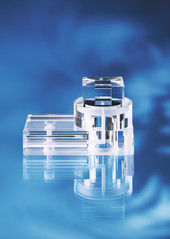
This cell is used as a reaction vessel to investigate the crystallisation of proteins under conditions of weightlessness. It is used in shuttle missions and on the international space station ISS. The reaction vessel is manufactured completely from quartz and fused directly according to the Hellma process.
The inner surfaces are polished with interferometric precision and have marker crosses for positioning. The outer surfaces are supplied with an anti-reflection coating.
Hellma Analytics in space
Protein Crystallisation Reactor
| Application | Reaction vessel for use in space, (e.g. on shuttle
missions and the space station ISS) |
| Special characteristics | Precisely polished interferometric inner surfaces
with cross makers. |
| Material | Quartz |
Precise Temperature ManagementThe PCR-02 reactor ensures accurate temperature control via its integrated cooling coil and digital touch panel. This allows researchers to maintain optimal conditions (4C to 60C) for protein crystallisation, a critical factor in achieving high-quality results. The reactors 0.1C accuracy guarantees temperature stability throughout the experiment.
Uniform Mixing and Visual MonitoringAdjustable stirrer speeds from 50 to 1200 RPM create uniform mixing, essential for consistency in crystal formation. The integrated LED lighting enhances visual inspection during operation, enabling immediate assessment of crystal growth without opening the chamber.
Safe and Certified OperationSafety features include over-temperature protection and leak detection, minimizing laboratory hazards. The unit is constructed from GMP-compatible materials (borosilicate glass, stainless steel SS 316) and certified under ISO 9001:2015, ensuring validated processes and regulatory compliance.
FAQs of Protein Crystallisation Reactor:
Q: How does the PCR-02 Protein Crystallisation Reactor maintain uniform mixing during experiments?
A: The PCR-02 is equipped with an adjustable stirrer capable of speeds from 50 to 1200 RPM, ensuring consistent mixing. This uniform agitation promotes even distribution of proteins and reagents, essential for reliable crystal formation.
Q: What safety features are included with this reactor, and how do they protect laboratory personnel?
A: Key safety features include over-temperature protection to prevent excessive heating, and active leak detection to minimize the risk of spills or contamination. These mechanisms support a safer working environment for laboratory staff.
Q: When should the integrated cooling coil be utilized during crystallisation processes?
A: The integrated cooling coil is used whenever precise temperature regulation is needed, typically during the stabilization and growth phases of protein crystallisation. It helps to maintain low temperatures, which can be critical for successful crystal formation.
Q: Where can this reactor be installed, and what setup considerations are required?
A: Designed for benchtop installation, the PCR-02 is suitable for laboratory environments with access to standard electrical supply (220 V, 50 Hz). Its compact dimensions (350 mm x 270 mm x 350 mm) allow efficient use of workspace without special infrastructure.
Q: What are the benefits of the USB and Ethernet connectivity for data logging?
A: The reactor features USB and Ethernet ports, enabling seamless data logging. Researchers can easily export experimental data for analysis, backup, or regulatory documentation, supporting both individual projects and collaborative studies.
Q: How does the GMP compatibility and ISO 9001:2015 certification impact research processes?
A: GMP compatibility and ISO 9001:2015 certification ensure that the reactor meets regulated standards for quality and reliability. This facilitates validated research and the reproducibility required in pharmaceutical and biotech laboratories.
Q: What materials make up the reactor chamber, and why are they chosen for laboratory protein crystallisation?
A: The chamber is constructed from borosilicate glass and stainless steel (SS 316). Borosilicate glass provides chemical resistance and visibility, while SS 316 ensures durability and biocompatibility, both crucial for precise protein crystallisation studies.

 Send Inquiry


 English
 Spanish
 French
 German
 Italian
 Chinese (Simplified)
 Japanese
 Korean
 Arabic
 Portuguese
 Get A Quote
 08045815658